Validating Warehouse Smoke Ventilation Under Real-World Conditions
A performance-based smoke ventilation strategy was developed for a large warehouse facility where roof-mounted smoke vents are automatically activated upon fire detection. The study was carried out using advanced Computational Fluid Dynamics (CFD) simulations in Fire Dynamics Simulator (FDS) to realistically model fire and smoke behaviour.
Warehouses present a particularly challenging fire scenario due to the presence of high fuel loads and the increased potential for rapid fire growth and spread. Therefore, it is critical to evaluate smoke control systems not only under ideal conditions but also under credible worst-case scenarios.
Standard Operating Conditions — No External Airflow
The base case represents standard operating conditions with no external airflow influences. In this scenario, smoke rises due to buoyancy and is efficiently extracted through the high-level roof vents.
A stable smoke layer is formed above the occupied zone, maintaining tenable conditions at lower levels and supporting safe evacuation. This confirms the system performs as designed under ideal conditions.
Wind-Driven Condition — Worst-Case Analysis
To assess system robustness, a sensitivity analysis was carried out considering wind-driven inflow through open roller shutters. This represents a credible worst-case scenario commonly encountered in real warehouse environments.
The incoming air disrupts the natural smoke stratification, leading to increased mixing, enhanced fire spread potential, and possible downward movement of smoke — all of which increase risk to occupants and responding emergency services.
System Performance Validated Against Both Scenarios
The study demonstrates that while the base case achieves effective smoke control with clear stratification, the introduction of wind significantly alters smoke behaviour. Despite this disturbance, the ventilation system continues to perform within acceptable limits, maintaining tenable conditions for a defined duration.
- Base case confirms stable smoke layer above occupied zone
- Wind-driven case shows increased smoke mixing and disruption
- Roof-mounted vents maintain acceptable performance in both scenarios
- Tenable conditions preserved for the critical evacuation period
Beyond Simplified Assumptions
In real-world warehouse fires, the combination of high fuel loads and external airflow can lead to unpredictable and hazardous conditions. By incorporating these factors into the simulation, this study goes beyond simplified assumptions and validates the smoke ventilation design against realistic fire scenarios.
This study demonstrates a critical principle in warehouse fire safety:
Smoke control design must account for real-world operating conditions.
By validating the ventilation system against both the ideal base case and the credible wind-driven worst case, this approach provides greater confidence in the reliability, safety, and resilience of the system — ensuring that it performs effectively when it matters most.
CFD Simulation Comparison
Base Case vs Wind-Driven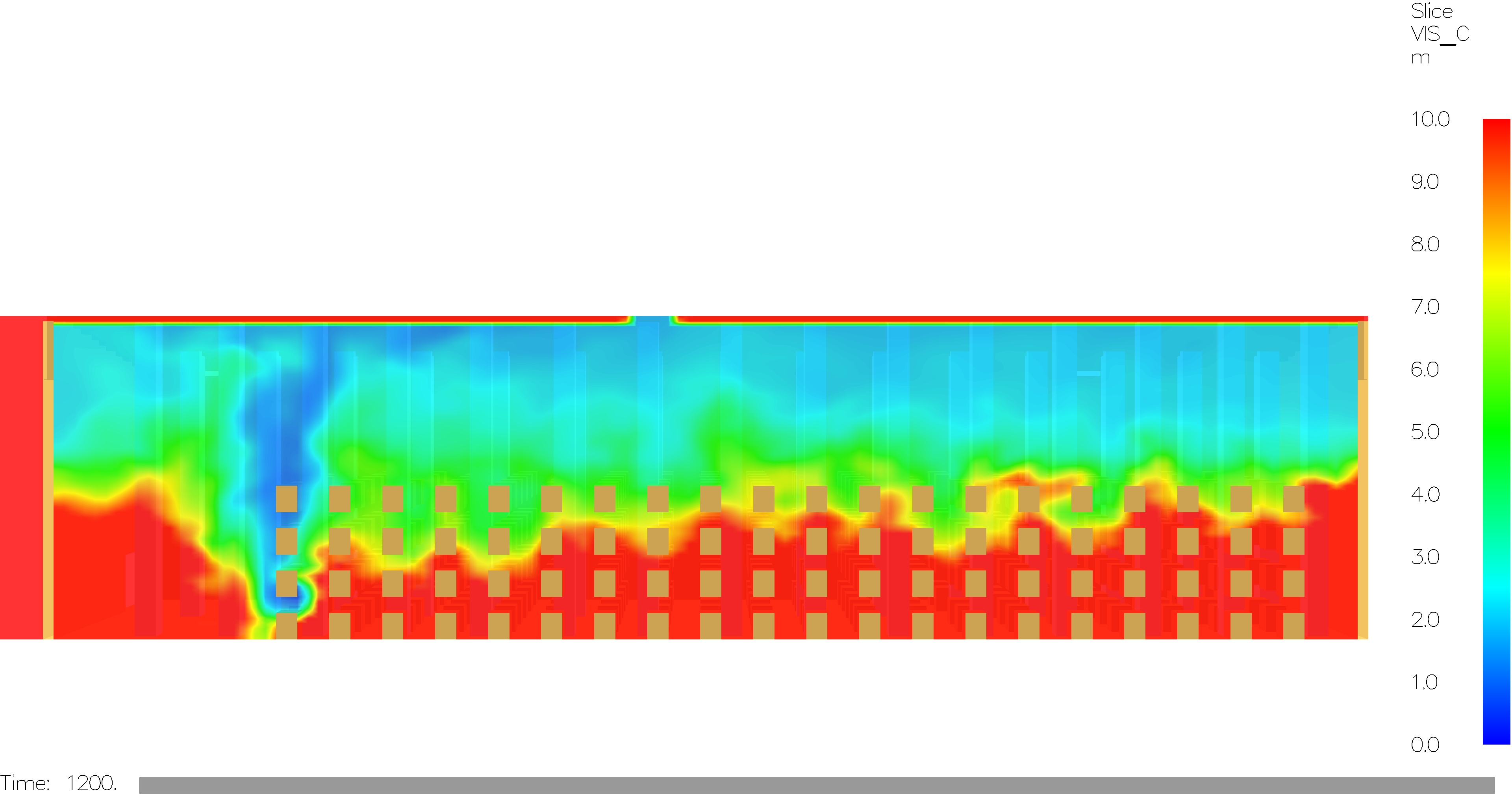
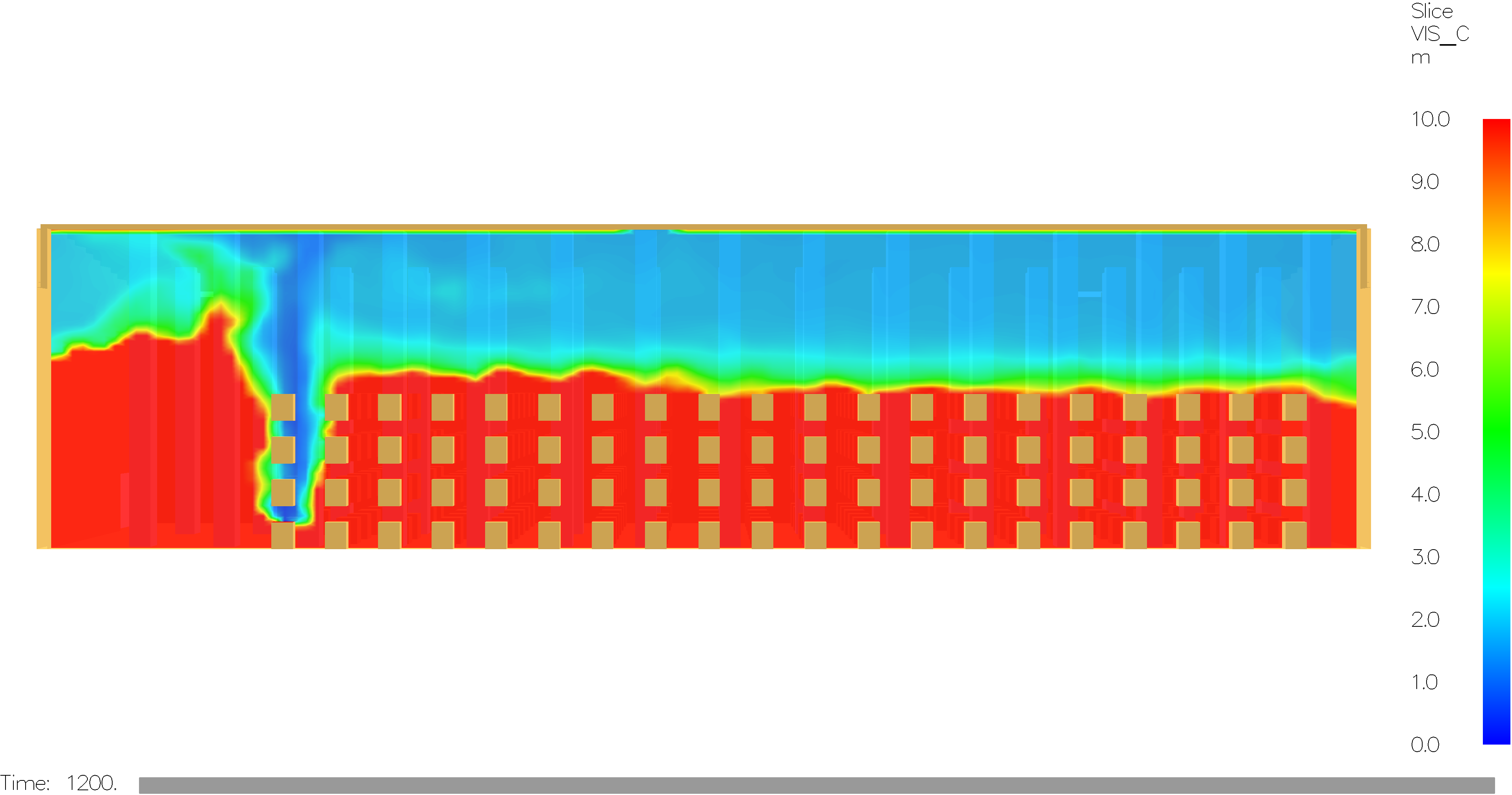
Base Case — Stable Smoke Layer
Smoke rises buoyantly and is extracted efficiently through roof vents, maintaining clear zones at lower levels.
Wind-Driven — Disrupted Stratification
Wind inflow through roller shutters disrupts stratification, causing increased mixing and downward smoke movement.